Friday, August 10, 2012

Worlds That Never Were: Books of Fictional Places


I've always been fascinated by maps and books that detail places, especially fictional places. These are some of my favorites of those books. I've linked to them on Amazon, but find them wherever you can; I don't have any kind of deal with that bookseller.


Gorgeous concept art and straight-faced prose paint a convincing picture of that doomed island. Skull Island is densely populated with the descendants of Cretaceous-era dinosaurs, as well as a riot of birds, reptiles, insects, mammals, and even humans, who have evolved in convergent and divergent ways. Cyclopean ruins loom over parts of the island, and are being reclaimed by the fecund and dangerous wild. A wonderful setting for adventure, only a tiny bit was explored in the Peter Jackson film. A detailed map and a fold-out size comparison chart of Skull Island's denizens helps round out this very nifty book.


The conceit of this book is that somehow man has vanished from the world, and fifty million years hence a mysterious naturalist explores the ecosystem of a world that would have been at once familiar but also very alien to man. A study in how evolution works, this book is also an intriguing bit of speculative fiction.


Dougal Dixon, the author of After Man, posits another alternate Earth bereft of humans. The time is now, but a "now" 65 million years after the dinosaurs did not vanish, but instead continued to thrive and adapt. Many of the animals are hauntingly familiar as they fill niches filled by animals we know today, while others are bizarre yet logical adaptations to new environments. A great companion piece to After Man.


Mankind has spread to the stars and is colonizing planets in other star systems. Detailed overviews of eight planets are the bulk of the book, with benefits and drawbacks for potential colonists given, as well as meticulous maps. The application to be a colonist is a fun added touch.


Profusely, and at times, disturbingly, illustrated, this Transylvania seems to be rife with sorcerers, barbarian swordsmen and -women, and demons and undead aplenty. Zombie farmers, cursed monasteries, guard towers on Hell's borders...all are discussed in serious guidebook prose, sometimes with a dry wit.
  
The League of Extraordinary Gentlemen, Vol. 2 by Alan Moore and Kevin O'Neill


This volume of Moore and O'Neill's adult-themed comic provides a fascinating prose overview and travelogue of the entire world. There are some amusing, and occasionally subtle, references - this is a world on which King Kong, Conan the Barbarian, and the Dude from The Big Lebowski have trod (or will).

 Invisible Cities by Italo Calvino 


Kublai Khan demands to hear of the many cities Marco Polo has encountered in his travels, but this isn't the historical Khan and Polo. The result is an unfolding dreamscape of cities that do not and cannot exist, but are beautiful all the same.


A thick, massive book, in which one can get lost for hours in the entries, which range from the familiar places of modern literature to the (very) obscure realms of centuries-old texts.


Using the original source material and a fine-honed attention to detail, the late Fonstad created this atlas, which could become indispensable to the Tolkienophile.

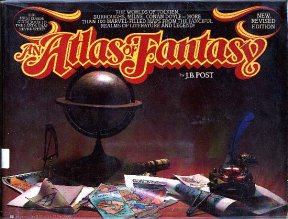
 An Atlas of Fantasy by Jeremiah Benjamin Post 


A fun collection of fictional maps, often from some surprising sources. A good rainy-day book.

Monday, August 6, 2012

Off the beaten path: Dunland and the Southern Misty Mountains


My philosophy is that I'd rather a game book go off the rails into lunacy rather than remain on the rails and be boring. Dunland and the Southern Misty Mountains is one of those instances where the rails are a mere suggestion, with a rail car bouncing loosely along, much like in Indiana Jones and the Temple of Doom. It never quite flies completely off and into the abyss of insanity, but you can see it looming below.

OK, so that's a bit of an exaggeration.

Much of the book is solid extrapolation, such as in how it attempts to derive the culture of the Dunlendings from what Tolkien wrote, or at least from what was suggested by what he wrote. The Dunlending culture in this book is vaguely Celtic in flavor. A good bit of the book is taken up with an overview of Dunnish culture, with attention paid to its history, tribes, customs, and territory. As a culture, they were traditionally hostile to the Dunedain and their allies, at least after they betrayed their oath to aid the Men of the West in their war with Sauron. The Dunlending culture was cursed, until by the time of The Lord of the Rings, they were a people in decline, living a desperate and wild existence in the empty lands in the southwestern part of the Misty Mountains and their surroundings. This is actually pretty interesting and useful material, even if one doesn't use it in the Middle-earth setting. As far as I can tell, most if it is made up whole cloth for this book. That's not bad, but it isn't a good source for Tolkienophiles.

Rohan and the Southern Misty Mountains
I've mentioned a number of times in this series of posts on the Middle-earth Roleplaying line that they have some beautiful maps. This is a good example of what I mean. It's only half of one of the maps covering the region detailed in the book. I chose to show this half because it covers some territory more familiar toTolkien fans - Rohan, Fangorn, and Isengard, called Angrenost on this map. It's quite a pretty map, a real work of art. It would have been fantastic had the entire thing been published as one big poster-map, but as far as I know it never was.

The Misty Mountains are an interesting locale in Tolkien's books. They harbor as many secrets as Mirkwood, it seems like. In The Hobbit, they are home to giants and underground goblin lairs. In The Lord of the Rings, they are home to Moria, also known as Khazad-dum, the legendary fortress-city of the Dwarves, now infested with orcs and much more terrible things. In both books, terrible storms seem to loom over them, waiting to strike, as though the mountains themselves begrudge those who trespass upon them. They retain this mystery and danger in this book, with giants, dragons, and Great Eagles calling them home. This is also where a touch of lunacy enters the picture.

Deep in the Misty Mountains, north and east of Isengard, lies Amon Lind...at least in the Middle-earth of this book. I can't imagine this place ever being approved by Tolkien himself. Amon Lind is an isolated enclave of Elves who moved from Ost-in-Edhil centuries ago to "escape" the "confines" of Elven society. For the most part, they are pretty tame in their "rebellion" against Elven society. The strangest among them, though, is a sadistic Elven version of Dr. Moreau, experimenting with the grafting together of Men and Elves with animals. He uses these animal-men as servants and guards. Add in that Amon Lind also has a flying boat at its disposal, and the boundaries of what is truly Tolkienesque are pushed to the breaking point. This would all be interesting in another setting, but they just don't fit in Middle-earth, at least not in my reading of the source material.

OK, so I'm always quick to point out that it's easy enough to ignore or alter things you don't like in these game sourcebooks. That's true in this case, too. Eliminate the mad scientist elf and his creations, and Amon Lind becomes a lot more palatable to a Tolkien fan like me. I'd also get rid of the flying boat, even though some might try to justify it by pointing out Earendil the Mariner had one...which is a pretty weak justification. Earendil was a special case, a legendary figure granted the mystical ability to carry the morning star on his brow. So let's be reasonable. Amon Lind, with those few tweaks, can be an interesting surprise for those who explore deep into the Misty Mountains.

So what else does Dunland and the Southern Misty Mountains have to recommend it? Plenty. The usual slate of charts of characters and critters that can be encountered in the region is here, as well as details of the flora and fauna. The stomping grounds of a dragon is located in the mountains, as is the aerie (or eyrie, as spelled in this book) of a Great Eagle. This Eagle also guards the final resting place of Isildur, Aragorn's long-ago ancestor, a nice reference to Middle-earth history. In addition, and perhaps one of the nicest touches, is a tiny hobbit village, its inhabitants among the stragglers who have yet to migrate to the Shire.

Wild Hobbits? You bet.
The bulk of the book deals with the Dunlendings and Amon Lind. The remainder of the book is varied and interesting. Some tragic history, a bit of whimsy, a hint of lunacy...it all adds up to a surprisingly interesting book.


A Space Opera Interlude: A Rising Thunder


The plucky Star Empire of Manticore has much more than its fair share of trouble to deal with on a regular basis. Whether it's political corruption or fleets of superdreadnaughts, the Manticore binary system has seen it all. This latest volume in David Weber's epic recounting of a future history once again ramps up the perils that are hurled at the little star nation, sometimes literally at hundreds of times the speed of light.

For those who wish to read this book or the entire series, be warned that I will be dispensing SPOILERS like a Manticoran task force dispenses missile pods. Which is to say, stop reading unless you want the story spoiled, 'cause I'll be spoilin' it but good. Haven't read the "Honor Harrington" series? Well, there's not much keeping you from it; most of the series is available for free, legal download at places like this, which hosts the material found on CDs bound into many of Baen Publishing's books. Tons of free reading, not all of it by David Weber.

This volume, the 13th in the series - though there two ancillary series consisting of two books each (so far) and a five-volume (and counting) series of anthologies - continues to expand the scope of the saga in ways which would likely astonish someone who has just started reading, or even someone reading just two or three books back.

I love these books beyond all reason. They're addicting. Some volumes seem extremely overwritten; maybe they are, but to me, Weber was laying an intricate foundation for what was to come. A millennium of history has been laid out. Several constellations worth of planets have been detailed, each with their own story. Hundreds, maybe thousands, of characters have come and gone, all with roles to play, sometimes reappearing unlooked-for, sometimes dying. It's difficult for me not to love such a fully-realized setting.

Never let it be said that Weber is afraid to kill off characters. He famously had marked even the titular character of the series for death in At All Costs, and you can see him building to it. He relented due to the influence of, among others, his wife, but even before that, he didn't shy from running Honor through a gauntlet in previous books. I have felt more than once she wouldn't survive the book I was reading at the moment. Though she has survived, many others, some long-familiar to the reader, have given up the ghost along the way. I'd gotten so used to the mortality rate for characters in Weber's books that I took the opportunity at a book signing to ask him not to kill off Admiral Lester Tourville - what can I say, I dig the guy. Weber jokingly replied that his wife had warned him to leave Tourville alone; subsequently, Lester almost tasted vacuum a few books later in a nail-biter of a space battle.  So the Fickle Finger of Fate seems poised, ever-ready to poke down on one character or another.

Get ready for the SPOILERS. Don't say I didn't warn you!

As the book begins, the newly-minted Star Empire is still reeling from a surprise attack in the previous volume in the series, Mission of Honor, that has left its industrial base in tatters. The assailant is still something of a mystery, despite the general direction of the attack's origin being known. 

Long-time Manticoran nemesis, the Republic of Haven, had been poised to surrender just as the sneak attack caused the recall of the mighty Eighth Fleet and its commander, Honor Harrington. Eloise Pritchart, president of the Republic, makes a surprising decision at the end of Mission of Honor of just how to take advantage of this respite from total defeat, one that would have been unthinkable not many books ago. She has received information from super-spies Victor Cachat of Haven, and Anton Zilwicki of Manticore, that reveals a conspiracy of such scope and age that it far outstrips that of the Illuminati, a conspiracy that has been using Manticore, Haven, and the Solarian League itself as pieces on a galactic board. Is it possible for Manticore and Haven to set aside their differences in the face of this secretive mutual enemy? Pritchart decides to take a chance in finding out.

The vast and ancient Solarian League, centered on Earth, with its capital in Old Chicago, smells blood in the water. The League, long in the background of the "Honor Harrington" series, has always loomed as the ne plus ultra of human star nations, its Navy seemingly invincible...seemingly. The lie was put to that in Mission of Honor, as the League was on the receiving end of decisive defeats at the hands of Manticoran fleets. The League, endlessly corrupt and imperialistic, now seeks nothing less than the total surrender of Manticore. The Solarian League Navy sends the largest fleet ever assembled in its history to the Manticore Binary System.

So, things are looking pretty bleak for the Star Empire.

A lot of criticism has been leveled at Weber for the decrease of space battles in this series, and the increase in endless Machiavellian political meetings. Certainly the recounting of ship-to-ship and fleet-to-fleet combat has become a rarer thing as the series has progressed. Weber is a true master of such scenes; he has meticulously figured out the technical details of his future weaponry and propulsion systems, and carefully lays out the physics and tactics involved in all his space battles. The specificity is what is appealing; there is no authorial hand-waving once battle is joined. Few things in science fiction literature are more satisfying than Weber's starship battles. What the critics seem to be overlooking is that significant chunks of even the talkiest book in the series is taken up by the descriptions of space conflicts. At this point, though, Weber has, in retrospect, clearly been laying the groundwork in the past several books for a grand conflict that involves all of explored (and some yet-to-be explored) space. All those clandestine - and some not-so-clandestine - political machinations are now bearing fruit, as the reader sees that a manipulative hand from the shadows has been guiding the course of conflicts for a long time.

A Rising Thunder has everything I've come to expect from an Honor Harrington book: starship battles; base treachery; astonishing technology; noble starship commanders; craven politicians; espionage; media manipulation; impassioned speeches; extreme melodrama; and much more, like the treecats of Sphinx pledging their support in the coming war. There's even a wedding. Yep, a wedding.

One of the things I like the most about this series is that while there are certainly bad guys and enemies that need defeating, Weber makes a point of providing any side of a conflict with sympathetic characters. I often feel more than a twinge when a battle brings characters I like on both sides into conflict. The Star Empire of Manticore is the home of the "good guys," but there are plenty of "bad guys," so to speak, that are likable and whom I wouldn't want killed - Lester Tourville, for example.

The Honor Harrington books compose my favorite science fiction series, bar none. A few books back I felt they bogged down and seemed unfocused. It seemed as though Weber was looking for a way to reconfigure the overarching plot for his future series after forgoing causing the demise of his most famous character. This is borne out by his assertion that his original plan was for Honor's son to become the center of the saga a couple of decades after his mother's death. He accelerated that plot to accommodate Honor's continuing existence, which took a couple of books to accomplish, and now the series seems to have come back on the rails. It's difficult to tell now if Weber has an endgame planned out, but I tend to think so. The decaying and fragmenting Solarian League provides both the opportunity to draw Honor's story to a close, but still leaves almost endless possibilities for future books in the "Honorverse." I hope so, because I have enjoyed being immersed in this setting, and this book brings the series back on track. Perhaps not the track of the earliest books, but it's an interesting ride, regardless.


Thursday, August 2, 2012

A Wizard in his Tower: Isengard and Northern Gondor


"My business is with Isengard tonight," Treebeard, The Lord of the Rings, The Two Towers, Book Three, Chapter IX: Flotsam and Jetsam 

Towers hold a certain kind of mystique in legend and literature. Jutting upward, pointing to the sky, they have an air of mystery to them, whether they appear in fairytales or occult legend. Rapunzel was imprisoned in one, Rumpelstiltskin spun straw into gold in one, Conan the Cimmerian found adventure in one, the Tower of London is steeped in history and legend, and, of course, the Tower of Babel may be the most famous of all.

The Tower of Babel as seen in Gustave Dore's The Confusion of Tongues.

 Even today, towers inspire fascination, with the skyscraper being the most prominent component of modern cities; having the tallest of these tall buildings confers considerable prestige upon the cities they shadow. Towers also loom up in other contexts in today's world, providing security in prisons, inspiration for worshippers, and nerve centers for airports.

So, it's not surprising, really, that Tolkien included so many towers in The Lord of the Rings. In Rohan, there was the Hornburg of Helm's Deep. Ancient Elvish towers stood to the West of the Shire upon the Tower Hills. The Tower of Ecthelion stood proudly above Minas Tirith. The Tower of Black Sorcery looms above Minas Morgul, which was once Minas Ithil, the sister-city to Minas Tirith. Grim Barad-dur is the focus of the greatest evil of Middle-earth as the abode of Sauron. 

And, of course, there was Isengard.

Well, technically, Isengard was the entire fortress, the ring of stone and the tower in its center. The tower was named Orthanc. Orthanc was built by some mysterious method in the Second Age of Middle-earth. It consisted of four piers (stelae? menhirs?) of obsidian-like material fused into one structure. I say "obsdian-like" because Tolkien describes them as "many-sided" and black, which strikes me as being a good description of obsidian, with the way it has facets when cut or broken.
See?


It seems it may not have been obsidian, or at least not normal obsidian, because it was impervious even to the Ents, who could easily rip apart stone walls when they were angry. It sure wasn't for lack of trying that they didn't damage Orthanc.

Isengard was meant to guard the western approaches to Gondor. As Gondor's borders slowly receded, it eventually became an isolated place, and was granted to the wizard Saruman as his sanctuary and laboratory.

Wizards have a long history in legend of being associated with towers. It makes sense, really; towers are defensible, and give a good view of their surroundings. They also can be imposing and ominous, scaring away intruders. They place their inhabitants up above mortal concerns, figuratively and literally, and provide a good place from which to study the sky. This is an important consideration because of the one-time close association between magic and the stars and planets. Astronomy and astrology were once the same thing, essentially, and they figured prominently in magic creation. Even Doctor Frankenstein worked in a tower, at least in the 1931 movie. I'd love to have a screen shot to show you, but I don't. Just take my word for it. So, it seems natural now that Tolkien included a wizard in a tower in his book.

I'm discussing all this because the bulk of Isengard and Northern Gondor deals directly with, obviously, Isengard, and especially Orthanc itself. There is some material on Calenardhon, the northern province of Gondor that a millennium from the time setting of this book, given or take a century, will become Rohan. Herbs, animals, some cultural notes on the inhabitants, items of note and legend, adventure ideas, the lay of the land, and histories of the region, Isengard, and Saruman are all included, succinct and useful. 

Interestingly, there is a brief overview of the Druedain, or Woses, the primitive, Neanderthal-like people who had some friction with the Rohirrim, which is more substantive than the entry for them in Riders of Rohan. Given the brief though important role they play in the Rohirrim making it in time to aid Gondor, it strikes me that more about them should have been included in the book about Rohan.
Theoden meets with Woses led by Ghan-buri-Ghan in this painting by the Brothers Hildebrandt.

The Hornburg and a few other, lesser strongholds and settlements are detailed, but like I said, the star of this book is Orthanc. A nice, color map of the tower is included, with an interesting depiction of the fortress from the outside. It's unusual for the Middle-earth Roleplaying line to include a color picture of a site on a map. The map shows the layout of the multiple levels of the place, and there are other maps showing underground levels.

By popular demand; not a great picture, but the best I could do with what I have.

When it comes to how the book covers Orthanc, it is strongly reminiscent of Dungeons & Dragons adventures. It's a pretty standard "dungeoncrawl," though there isn't a lot of variety in the inhabitants of the place - mostly Men and Orcs, the latter appearing after Saruman's treason. There are quite a few tricks and traps to vex invaders. Oh, and Saruman lives here after a certain point. That makes the place especially dangerous.

This entry in the Middle-earth Roleplaying line is solid, though not as interesting as others in the line. The cover art is by Gail McIntosh, who did some of the covers for early books in the line. It's a well-done picture, but I think an image emphasizing Orthanc more would have been appropriate. The interior art is pretty sparse, and only one depicts anything of note, and even then it took me a while to realize it was meant to depict Saruman and Wormtongue.
Umm. No.
In all the times I've read Tolkien's book, I never had an image of Saruman anything close to this. And let's not even bother to discuss Wormtongue in this picture. I always thought the interior art in the MERP books was very hit-or-miss, and this book was a definite miss. From a technical standpoint, it was actually pretty good:

But from the standpoint of really evoking the setting? It just doesn't work. I suppose that the paucity of art in the book was actually preferable to a lot of art that didn't seem all that tied to the setting.

This book is an interesting contrast to the previous one I discussed, Riders of Rohan. I think I've had it even longer than that book, as Isengard and Northern Gondor is definitely from earlier in the history of MERP. Regardless, I've forgotten I owned it from time to time, including when I started to do this series of blogs. Doing the Rohan post jogged my memory, and I dug it out to write about next because it complements the Rohan book. I see why it doesn't evoke any kind of deep memories; it seems thin to me. Had it focused more tightly on Isengard itself, making it more of a site-based adventure, it may well have been a classic of its kind. As it is, it's useful, but forgettable.


Sunday, July 29, 2012

Vikings on a sea of grass: Riders of Rohan


     "'You cannot enter here,' said Gandalf, and the huge shadow halted. 'Go back to the abyss prepared for you! Go back! Fall into the nothingness that awaits you and your Master. Go!'
     The Black Rider flung back his hood, and behold! he had a kingly crown; and yet upon no head visible was it set. The red fires shone between it and the mantled shoulders vast and dark. From a mouth unseen there came a deadly laughter.
     'Old fool!' he said. 'Old fool! This is my hour. Do you not know Death when you see it? Die now and curse in vain!' And with that he lifted high his sword and flames ran down the blade.

     Gandalf did not move. And in that very moment, away behind in some courtyard of the City, a cock crowed. Shrill and clear he crowed, recking nothing of wizardry or war, welcoming only the morning that in the sky far above the shadows of death was coming with the dawn.
     And as if in answer there came from far away another note. Horns, horns, horns. In dark Mindolluin's sides they dimly echoed. Great horns of the North wildly blowing. Rohan had come at last."

- J.R.R. Tolkien, The Lord of the Rings, The Return of the King, Book Five, Chapter IV: The Siege of Gondor

"Rohan had come at last." Such a simple sentence. Yet in all the books I've read in my life, few sentences have touched me on such a deep level. No matter how many times I've read The Lord of the Rings, I still find my throat growing tight and a surge of hope welling up in my heart everytime I reach this passage. In a literal sense, the cavalry rode to the rescue in the nick of time, just as everything seemed lost.

That's why ICE's Riders of Rohan, another in their Middle-earth Roleplaying (MERP) line, fired my imagination more than most of these sourcebooks. The Riders of Rohan, or Rohirrim, are actually a fairly unique creation on the part of Tolkien: a Norse-like society centered on horses. It may not be Tekumel or Skyrealms of Jorune, but it is a bit off the beaten path for the fantasy genre, at least at the time the Lord of the Rings was published.

This book differs from the last few sourcebooks I've discussed in an important way - the inhabitants of Rohan are mortal, and their realm is relatively new. As with most of ICE's Middle-earth books, the default time setting is about 1400 years before the events of The Lord of the Rings. However, this presented a special problem for the authors of this book, because Rohan was not even in existence then, and wouldn't exist for close to a thousand years. The land which would become Rohan was still the northern part of Gondor.

However, the time period is a pivotal one in Middle-earth's history, as much of the continent has only recently been devastated by a plague that has weakened Gondor and depopulated much of Middle-earth. The ancestors of the future Riders of Rohan originated to the East, and migrated West, to just short of the eastern edge of the Misty Mountains. Centuries later they would migrate North, and even later they would move South where they would found Rohan and become the culture familiar to book readers and moviegoers.

By necessity, this sourcebook had to widen the usual scope of these books to accommodate the varied history of the Rohirrim. It's a bit of a shock for those used to sourcebooks for Elves and Ents to run across a culture more akin to something from our own history; consider how much any culture in the history of the real world has changed over the course of 1400 years. Consider also that this book traces the origins of the Rohirrim back 3000 years, and it's remarkable how coherent their culture remained. Even so, Tolkien's timelines suggest an interesting, ever-evolving culture that managed to retain its core essence - that of mounted warriors.

I'm once again impressed with how densely-packed with information the MERP staff made this book. They manage to cram in all of the information about the Rohirrim from Tolkien's timelines, as well as cultural overviews of the three main phases of their development as a culture: the Eothraim of their Eastern origins; the Eotheod of their emergence as a power in Eriador, the section of Middle-earth with which we're most familiar; and, finally, the Rohirrim. Not only that, but the MERP writers also included notes on the climate, flora, fauna, and weather of each region these peoples roamed. They even managed to crowbar in overviews of friendly and rival cultures of the Rohirrim, from Easterling horsemen and wagon-riders to Elves and Gondorians. And that's just the cultural and historical stuff.

Also included are a number of gaming ideas and aids. These include adventure ideas, with some tailored for each era. There are sources of possible conflict, events mentioned by Tolkien but never fully detailed, and sites where players can have their characters explore and interact with the setting. This includes a dragon's lair, which isn't a common thing in Middle-earth or in Middle-earth Roleplaying books. There is also a selection of biographies of people of note for each era, including the ones you expect: Theoden, Wormtongue, Eomer, and Eowyn.

Eomer and Eowyn...another instance of a picture that seems to show a slight pause in an argument.


Of course, if you've read any of my other posts about these books, you might have come to expect my mentioning the inclusion of charts and tables of military units, characters, and animals. Last but not nearly least, there are maps, from floorplans of buildings to city layouts to regional maps labeled with the locations of plants, animals, monsters, and people.

This book is 64 pages long. 64 pages. I haven't even mentioned the usual, tedious game infodump at the beginning of the book, or the numerous illustrations. It's amazing.

I've discussed how MERP books are jammed with info, but this particular book seems especially meaty. It details an entire culture over the course of 3000+ years. It can be used in its original setting, or plugged into another setting after the numbers are filed off (or not).

By the time this book appeared, ICE had hit its stride with the Middle-earth Roleplaying game line. There is little wasted space. It's meticulously put together, with an eye to accommodating both the Tolkien fans and gamers. The illustrations are well-done and relevant. For example, Liz Danforth does some yeoman's work in this book, with one of my favorite illustrations by her:

Pivotal kings from Rohirric history, illustration by Liz Danforth.
  

She manages to capture the "feel" of the setting right there. I particularly like how Theoden stands among his mighty ancestors, unclad for war as they are, looking drawn and slightly bedraggled, yet possessed of the same nobility. That picture alone would have made me a fan of Danforth's work; there are many others.

The late Angus McBride provides another MERP cover, this one especially dynamic. McBride also did work on sourcebooks of historical military units, primarily by Osprey Publishing, which are used by those who paint miniature figures for wargames, and other historical buffs. His attention to detail was second to none. I've mourned his passing more than once, and I'll do so again. He passed while still in the midst of producing fantastic artwork, still at the height of his powers. One of the obituaries I read noted that he had wished to do an illustrated edition of The Lord of the Rings, and boy, do I wish he'd had the chance to do it.

I've waxed nostalgic while discussing these Middle-earth Roleplaying books, inspired by the memories of times past that they trigger. In some sense books are especially good at casting one's mind back in time, as the reading of a book involves a melding of one's own experiences at the time of reading, as well as a certain kind of objective reality as the book itself, both the writing and the physical presence of it, don't change. Perhaps that's why I re-read certain books from time to time, to either transport myself back, or to somehow change an associated memory, ameliorate it if it was unpleasant. Perhaps...

Sunday, July 22, 2012

Ents of Fangorn: Finally, an elf-free forest.


Tolkien really seemed fascinated with forests. He portrays all of them as being inherently perilous, and all have a mystery to them. As mysterious as they all were, Fangorn was probably the most enigmatic of the forests he placed in Middle-earth. Well, second-most, behind the Old Forest near the Shire, which was Tom Bombadil's domain. Actually, though, both were the remnants of a truly ancient superforest that covered a big part of Middle-earth at one time, so in some respects they're very similar. I'll give the nod for being strange to the Old Forest, simply due to Bombadil's presence. But Fangorn is a close second, and is, in some ways, more dangerous, because there is no brightly-dressed gnome around to save the day. Regardless, Fangorn is yet another of Tolkien's haunted forests, and one inhabited by some of the stranger inhabitants of Middle-earth.

Ents of Fangorn gets right to the point with its title. I guess that's understandable. After all, any trek to Fangorn is going to have to involve meeting an Ent or two, or you'll be dealing with some disappointed players. It's inevitable. Doesn't matter that Ents are so rare as to have never been seen - or even heard of! - by most of the people of Middle-earth, even Elves. Players will want some facetime with Treebeard. So this book rightly discusses the Ents for a few pages, detailing their culture and a few notable Ents. The most notable is Treebeard, of course.

One thing that's always bothered me in my numerous times reading the book is how hard a time I had visualizing Treebeard, or any Ent, really. I mean, I got that they were anthropomorphic trees, or at least resembled such. It didn't help that I was not too keen on any of the pictures I saw of him. I was reading Lord of the Rings once every couple of years long before Peter Jackson's movies, so my main source for Treebeard pictures were in things like Tolkien calendars by the Brothers Hildebrandt.

From the 1976 J.R.R. Tolkien calendar by the Brothers Hildebrandt.

The Hildebrandts were phenomenal, of course, but some of their interpretations never quite clicked with me. Treebeard was one such. I think they were good about reading the source material. Technically they did a great job. But it just didn't look like Treebeard to me. Still, the only alternative I had back at that time was from Ralph Bakshi's Lord of the Rings animated film.


That film has its fans, I know, and I can understand. It's ambitious. Nobody else tackled it as a feature until Peter Jackson. I was not a fan, really, because I never cottoned to Bakshi's penchant for rotoscoping, and I disliked some of the character designs - and Treebeard was one of those. It's not bad, but it's just not what I envisioned as I read the book. The closest to what I pictured in my own personal theater of the mind was the Treebeard of the Jackson films, and that came years later.


Took me a while, but I warmed up to this interpretation eventually. It came to really imprint itself on my mind's eye.

I'm spending a lot of time on Treebeard because he is Fangorn, literally. That's his original, given name. Whether he was named after the forest or it was named for him isn't entirely clear, but I like to think Fangorn, the Ent, came first. He is the eldest of the Ents, and my own interpretation of what Tolkien wrote is that he was the first Ent. That may not be true, but it's the impression I got. Regardless, he's the oldest of them living in Middle-earth at the time of the Lord of the Rings. He left one of the deepest impressions on me while reading the book. He seemed like someone's old grandpa, absent-minded, slow to speak and act, but also warm-hearted and paternal.

Ents of Fangorn covers its subject with the usual MERP structure: game infodump at the beginning, history of the area, overview of flora and fauna, and charts and tables of critters, military units, and even weather. As with the Mirkwood books, it covers the region surrounding the forest. Bandits and orcs in the mountains provide potential for helping out the Ents, if need be. There are also some great maps, as usual with MERP books. I said with Mirkwood that the map labeled with the territory of creatures and characters is perhaps the most useful thing provided, and that's true here, also.
Treebeard's dwelling, where he hosted Merry and Pippin.
A nice side cutaway view of another location in the forest of Fangorn.

 All in all, it's a nice package, with a bit of reading for those interested, and enough game material to provide for a good slate of adventuring.

The downside is, as with a lot of MERP books, the time setting. The default here is that the time period is roughly fourteen hundred years before the time of the Lord of the Rings.While the forest of Fangorn doesn't change much at all, the entire political and cultural landscape surrounding it in this book is vastly different from what readers and movie viewers are used to. No Riders of Rohan and no evil in Isengard are the biggest differences. Given Fangorn's nature and the nature of Ents, though, this isn't an insurmountable problem. Used as a game source for just the forest, it's useful in any time period. The surrounding region's adventure sites are easily adaptable for other times, too. Still, it's a bit of a pain to have to fiddle with such stuff when I've paid for a book that ostensibly was exactly what I was looking for.

I want to mention the art in this book. The cover above is, as per usual with most MERP books, by the late Angus McBride. I always thought he did great renditions of Hobbits. His depiction of Treebeard is actually really nice. He nails the eyes, which were always one of the most distinct things about Treebeard as described by Tolkien. Wellinghall, one of Treebeard's homes, looks like I imagined it. McBride was a masterful artist, and his loss is still felt.

The interior art is by Liz Danforth, whom I've mentioned before. I'm a bit torn about her art in this book. She does great work on characters like Tolwen, an Elf healer who lives at the edge of the forest:


Or Malion, a Gondorian knight who is a captain of a settlement in the region:


Her depictions of Ents are distinctive:


Not bad. In fact, very good. Not the way I envision them, but nice in and of themselves.

Where I feel conflicted is when it comes to her depictions of Fangorn itself:


These are actually lovely pictures. Very evocative. However...Fangorn is an old-growth forest, primordial, foreboding, essentially the same as it has been for millennia. These pictures seem more like what I imagine Lorien would look like: smooth, subtly cultivated, almost ethereal. So, yeah, great pictures, but they don't fit the subject. But I'm not complaining, really. Danforth's work is among the best in any roleplaying game book.

One last picture I wanted to mention is by Jim Holloway. Holloway is one of my favorite artists working in roleplaying games. His stuff is memorable and often humorous. He did a lot of work for Dungeons & Dragons, as well as Middle-earth Roleplaying during the era this book was published (1987). Humorous or serious, his work is always fun, and it was a nifty surprise when this picture showed up towards the end of the book:


Nice. 

It doesn't fit the tone of the book, but anything by Holloway is welcome.

 The more of these books I go back and go through, the more useful they all seem now. I also feel a sort of low-grade stun when I see that this book is 25 years old as I write this. Incredible. It doesn't seem that long ago that I bought it. I've gone on and on about the passage of time and the emotional journey I go through again as I look at these books. It's weird to think how even the most trivial thing, the most insignificant purchase, can become a signpost of one's life simply by continuing to exist for long enough.