Showing posts with label King Kong. Show all posts

Sunday, March 26, 2017

A leisurely South Seas cruise...to Skull Island, redux.


It's a good time to be a King Kong fan. Peter Jackson's King Kong is still fairly fresh in memory, and now Kong: Skull Island comes along to tell the tale of the big ape from a different perspective. Not to mention a clash of kings on the horizon: King Kong vs Godzilla, the King of the Monsters, coming in 2020.

Now, I'm a lifelong King Kong fan. Something about gorillas, giant or not, involved in adventure tales has always intrigued me. But they have to look like real gorillas, or like a reasonable offshoot or mutation, or like they share a common ape ancestry. If they fulfill that one stipulation, I'm there. So when I began seeing the promos for Kong: Skull Island, I was instantly jazzed. He didn't look like a gorilla, true, but something fascinatingly different; possibly an ape of his own ilk, with similarities to gorillas, chimpanzees, and, hauntingly, perhaps a dash of proto-human? Turns out: Yep.

Of course, along with Kong is his home of Skull Island, a location every bit a character as the ape. I wrote an overview of a book the Weta Workshop published about Peter Jackson's version of the island, which details it to such depth that it seems tantalizingly real. This new iteration may not have as much detail worked out - Jackson's Skull Island had a complete ecosystem worked out for it, for cryin' out loud - but it's a big, foreboding presence in and of itself.

The trailers and posters for the film had it all: a mysterious island; big, nasty monsters; enough characters that you knew the body count would be high; a surprisingly high-powered cast; all kinds of helicopters getting swatted from the sky; and, of course, Kong himself. And what a Kong! At least a hundred feet high, and as full of piss and vinegar as you'd want in a giant ape.

So I was excited to see this flick. The monster kid in me awoke from a long slumber. It's becoming less and less frequent for something to capture my imagination in a way that dredges up that long-gone kid hunkering down with dinosaur books and comics on quietly late Ohio nights. It now feels like an event to take note of when his ghost walks in on me, a grizzled old man.

I'm going to be delving into SPOILER territory, so if you have yet to make your own trek to this iteration of Skull Island, be warned from here on.

They don't skimp on Kong in this movie. Maybe 20 minutes or so of establishing the who, what and where of the expedition, as well as an opening dash of World War II mayhem. Then a jump ahead to 1973 for a whirlwind of scenes in Watergate-era Washington, D.C., Da Nang in Vietnam as US forces are drawn down, and neon-lit Thailand. Soon enough, though, our favorite simian star is duking it out with a crack helicopter squadron, fresh from duty in 'Nam. That's just for starters. They don't skimp on the action in this flick, either.

That cast I mentioned rates a bit more discussion. Sam Jackson is here, bringing his trademark badassery to the role of an army colonel who broods about the end of a war he seems to have wanted to keep on fighting. John Goodman is a scientist withholding some damned important information about the expedition he's trying to mount. Tom Hiddleston is a retired British SAS officer hired on as a civilian guide and tracker. John C. Reilly is a good-natured but slightly off WWII pilot stranded on the island since 1944, half-crazed, but still sane enough to warn everyone where not to go (but, of course, they go anyway, with Reilly bitching in an amusing and wholly realistic way). Brie Larson is a photojournalist, suspicious of the expedition's purpose. It's almost a stock roster of characters, really, with the traits and motives moved around a bit, but it works. Round it out with a platoon or so of soldiers and a small think-tank of scientists, and off we go into the wild.

The film helpfully scatters it cast all over the island during the Kong-vs-'copter brouhaha, so we get to see a decent cross-section of the place. Beautiful scenery: check. Appallingly violent and often disgusting fauna: check. Mysterious lost civilization with a giant wall: check. I say "check" in a flip way here, but these are things I think are essential to a King Kong story. But this story is not exactly like those that came before it.

That native civilization doesn't fear Kong; that wall is to keep out the nastiness he battles on a regular basis. He's a god to them, but a protector, too. Plus, according to Hank, the WWII pilot, these folk seem to be immortal.

And Kong is still growing.

This flick throws a lot at its audience, from the aforementioned tidbits about immortality and a giant ape who hasn't hit his adult height yet, to the hollow Earth and an almost-assuredly misguided dismissal of extraterrestrials. I love this, this willingness for a film to trust its audience to not be overwhelmed by an influx of high strangeness. So many movies, before the comic book film genre exploded, doled out their big concepts with a tight fist, limiting them to one, maybe two, as though the audience would have its collective mind blown by too much brain-bending. Not so now. Hollywood relies too heavily on remakes and well-worn concepts in this era, but even within those stifling confines you'll still find references to quantum theory, time travel, and the multiverse tossed out without the proceedings being ground to a halt to explain everything to the viewer. Depth has taken up a bit of the slack lost when breadth was diminished.

There's a lot to like about Kong: Skull Island, but it has flaws, for sure. Characterization suffers due to the size of the cast and the relentlessness of the action. Sam Jackson and John C. Reilly have strong enough screen presences to connect with the audience. So does John Goodman, but his role recedes during the course of the film. The rest of the cast acquits themselves well, but the sheer scope of Skull Island and its inhabitants dwarfs them by comparison.

But, man, this is a fun movie. It bodes well for future monster flicks. And there will be more. Which leads me to say: stick around for the credits and wait for them to end. I mean, in this age of post-credit scenes, I know it can get tedious. But if you're a giant monster fan, it's worth watching until the house lights go up. It bummed me out a bit to see the admittedly small audience I saw it with early on a bitterly-cold Thursday morning bail as soon as credits began rolling. There's a bit of heartwarming early on, then a bit of ooooooooo at the end.

I wish there was some way to toss a note back to that kid version of me, so long ago and getting even further away in the time stream, receding from my sight, some of the memories now blurred and getting even more murky, just to say "hang on, buddy, you'll get more of those monster movies." I suppose I could better use that time-traveling note-throw ability by saying something like "don't answer that message from [name redacted]" or "pick a different major" or "don't fear losing one job so much that you don't look for another." But, hell, maybe just knowing a kick-ass Kong movie was coming might have sparked something, made me think about the future differently. Probably not. But it's nice to think.

Sunday, December 22, 2013

A leisurely South Seas cruise...to Skull Island.


You know as well as I do, probably better, that none of us live in a vacuum. Our lives are a string of moments that teach us something, whether we choose to learn from them or not. Most of those moments aren't labeled as lessons in big, bold letters, so too often we ignore them and move along, searching and waiting to find the "real" lessons we are sure will rise into view over the horizon with luminous sails. But that's never how it is, is it?

Sometimes it's seemingly inconsequential things that have stuck with me throughout my life, causing me to reflect back on them to suss out their meaning countless times. So many moments, preserved in memory like flash-lit photos, barely noticed while happening, yet treasured for decades. A lingering glance across a frozen parking lot, a hushed conversation in a kitchen lit by the light of an old stove, a laugh shared with strangers in a crowded check-out line, a childhood argument bitterly fought on an Autumn playground, a passage from a book read at random in a cramped library, a missed phone call presaging years of silence...they all add up to a greater meaning, if only we take the time to figure out just what that meaning is.

When I write these blog posts, I hope that it's clear that most of the ostensible subjects are really MacGuffins. That is, while they are interesting in and of themselves, for me they are vectors to talk about and ponder larger issues. They are outward manifestations of an inner life. I try to approach what I'm talking about with concrete examples, and even if those examples are not the cup of tea of any given potential reader, I would also hope that the underlying intent is of some interest.

I've been a dinosaur fan since I was a kid. Even more fascinating to me are prehistoric mammals. Now, don't get me wrong, I find modern animals fascinating, too, but there is something haunting about the vast array of creatures that roamed the planet before the advent of humans. The Earth spun silently on in its solar revolutions for eons, while life spread and throve and died and returned in different forms. What we see today is a snapshot, a moment caught and examined in detail by those with the ability to really see the larger mural of existence on this planet. It's almost heartbreaking to think of all the animals that are long lost, both the ones we know about via fossils or historical record, and the ones we will never know existed. Much of what we know has to be inferred from what evidence was left behind, leading to a lot of speculation, and, by extension, fiction. So tales of dinosaurs and other prehistoric critters enthrall me, as they make me consider what they may really have been like.

It is inevitable, then, that King Kong would have piqued my interest. Back in the days before home video and cable TV, I had to wait until Thanksgiving to see what was, for me, the ne plus ultra of dinosaur movies. A local UHF station played it Thanksgiving night for years. I was easily frustrated by all the non-Kong stuff going on in the movie; I knew what people were like, for crying out loud! I needed to see what the dinosaurs and giant apes were like. It was a window into another world, and I didn't want it blocked by silly romances and huckster schemes. Kong and the dinosaurs of Skull Island were clearly the stars of the movie, even if RKO didn't seem to get that.

Time marched on, as it does, and King Kong, while retaining its mystique for me, had become time-worn and known inside-out. So, too, was its sequel, Son of Kong, which had revealed an even more varied ecosystem for Skull Island than was evident in its predecessor. There were plenty of dinosaur flicks and TV shows that came later, especially with the rise of computer-generated effects, but none held the same potential to evoke wonder as King Kong. Peter Jackson would do a remake of it in 2005, which, while drubbed critically, still managed to recover some of the magic of the original - this Skull Island was a worthy successor. Riotous with life, dangerous as a green Hell, and a glimpse into a world that might have been, but never quite was.

Some years back, I snagged what I still feel is the coolest movie tie-in book I've ever seen: The World of Kong: A Natural History of Skull Island. The book was by the Weta Workshop, the special effects folk responsible for both the Lord of the Rings movies, and the 2005 King Kong, all of which are Peter Jackson movies. Say what you will about Jackson's Kong, but the amount of work and detail put into the creation of Skull Island is astounding. I wrote a review of the book a long while ago, but I thought I'd post it here, too.

Books like this are the kind that can stick in one's memory for years. Sure, it's a fictional place, but it takes reality and tweaks it a bit into a tantalizing glimpse of what-might-have-been on some alternate timeline. I put it alongside the atlases and encyclopedias on my bookshelves, as well as other "never-were" books like After Man. To me, it adds a touch of wonder for both young and old alike to compare, contrast, and dream about far-flung places both imaginary and existing, to contemplate the borders between the real and unreal and where they shade into each other.

Introduction

The discovery and subsequent expeditions to Skull Island until it disappeared beneath the waves are revealed. The gradual shrinking of the island as it sinks into the sea is discussed, and the reader learns it is due to volcanic activity. Also discussed are the huge ruins that seem to have covered a large part of the island at one time, the builders of which are unknown.

I. The Crumbling Coast and Village

While some of the coastal creatures – such as large crustaceans and various water-loving animals like reptiles and amphibians, as well as birds and other flying creatures – are detailed, the human village is of even more interest.

The humans here are a dwindling, desperate lot, pushed to the limits of existence as they are forced into more and more inhospitable living conditions due to the encroaching sea. They are of a racial stock unlike any that are indigenous to the region, and could be the descendants of the builders of the ruins. If so, they have lost any memory of their history. The ritual sacrifices to the mighty Kong are also discussed.

II. The Shrinking Lowlands

The primary domain of the true heavy-hitters of Skull Island’s dinosaur set, such as the brontosaurus (yes, brontosaurus, not apatosaurus) and the V. Rex (V standing for vastatosaurus), a big, meat-eating tyrannosaur descendant.

The implication of this chapter is that as Skull Island sinks, the competition for territory and food forces the animals here to live a life of constant danger and violence. With so many large, dangerous animals squeezed into an area getting smaller everyday, the place becomes almost cartoonishly violent.
A study of how Skull Island is sinking.

III. The Winding Swamps and Waterways

Called the “Blood of the Island,” these wet areas ensure the sustainability of life on Skull Island.

IV. The Steaming Jungle

Perhaps the most familiar part of Skull Island, the jungles contain probably the greatest variety of life. Life forms range from graceful ceratopsians to proto-monkey creatures. There are flying lizards (“flizards,” not quite pterosaurs), a wide array of nasty-looking insects, “flying rats,” strange sorta-bats, and “burglar monkeys” (the aforementioned proto-monkeys) inhabiting the forest canopy. Below, giant flightless birds, huge centipedes, and lots of large, nasty lizards prowl the jungle floor.

V. The Abyssal Chasms

This is the deep, dark, dank, and perhaps most alien region of Skull Island. Deep fissures cleave the island, and are kept moist by the tropical climate, and very warm due to volcanic activity. Spiders, giant worms with big, nasty teeth, and weird, pterosaur-like “vultursaurs” lurk in these areas. Think of what you find under a rotting log, mix it with a lot of fungus, and make it all really big and hostile, and that’s what you have here.

VI. The Barren Uplands

While inhabited by a variety of creatures, such as the bifurcatops, an agile ceratopsian that fills a mountain-goat-like niche, this region is most notable for the giant apes that claim it. How and why a species of huge, gorilla-like primates came to exist on Skull Island is discussed, but a lot is left to speculation.

An interesting idea that is presented is the notion that these creatures were brought to the island by the mysterious ruin-builders, and bred into their giant size from gigantopithecus stock. The species’ gradual decline, until only the mighty Kong remained, is discussed, as is the demise of Kong himself, and provides a melancholy end to this book.

Size Comparison Chart

A fold-out section at the end of the book shows the various creatures of Skull Island standing placidly in profile on a New York City street. We get to see just how large all the dinosaurs and other animals are in relation to each other, as well as in relation to humans (such as Ann Darrow/Naomi Watts), biplanes, and New York’s elevated trains.

The Good

This book conjures up Skull Island as a fully-realized, living, breathing place. It’s such an interesting place, that it makes me wish there really was such an island in the world. The book never “breaks character” and dispels the illusion, treating its subject with respect and perhaps a bit of awe. This includes a rather neat vintage-looking map on the inside covers and end-papers of the book, as well as several maps showing the climatic/ecological regions of the Island. It really seems like a place I’d like to…well, not visit, really, since it’s so dangerous. OK, maybe I would like to visit it; it's too tempting. But I’d definitely love to see a National Geographic special on it.

Another neat thing about the book is that the creatures on Skull Island are not simply frozen-in-time hold-overs from the Cretaceous era. They are descendants of the animals from that time, and have evolved various specializations over the eons.

The Bad

Honestly, I can’t find a legitimately bad thing to say about this book. I only wish it was longer and contained more artwork.

The Ugly

The carnictis sordicus is a species of intestinal parasites that somehow evolved into giant worm-like creatures, and which live deep within the chasms of Skull Island. Described as “animated stomachs” with a “sphincter-maw of teeth,” these critters made a pretty spectacular and, yes, as the book says, repulsive appearance in the recent King Kong movie. Very creepy, shudder-inducing fellas.

Why You Will Like It

Perhaps first and foremost, this book is gorgeously illustrated. The images are clear, vivid, and fire the imagination. The detail put into the ecosystem, while pushed to the limits of credibility and beyond, still shows a lot of thought and effort. This makes the book a fun read as it straight-facedly presents Skull Island as a real place.

Why You Won’t Like It

If depictions of unrealistic, pulp-magazine style jungle-clad islands inhabited by dinosaurs and giant apes don’t appeal to you, then you probably won’t like this book.

Where’s the Fun?

The fun is in the sheer chaos of the island’s ecosystem. It’s bright, colorful, over-the-top adventuring fun. Really dangerous bright, colorful, over-the-top adventuring fun. There is a cliffhanger (often literally) every few yards, with the fauna (and maybe even some flora) out to eat the unwary. Realistic? No. Fun? Hell yeah.
Giant Apes + Dinosaur Fights=Fun

Final Assessment

I love this book. It’s the best movie tie-in I’ve ever had the pleasure of reading and looking at. It can be read as a study of a place that never was.

One of the things I didn't emphasize enough, regardless of the pictures I posted, is just how beautifully illustrated this book is. There are no stills from the film; the art consists of concept paintings and drawings from the Weta Workshop, which did the special effects for the film. This is an important point, I feel, as the book establishes its own identity separate from the film. One could comfortably read and enjoy the book without ever having seen the film. 

But what does all this have to do with anything? For me, it points up the wonder and fragility of life. It shows the importance of imagination, and the firing of that imagination. It represents the manifestation of a memory, and childhood flights of fancy that can still thrill an adult. Most importantly, though, I wanted to write about Skull Island. I hope others like reading about it, and both "get" why something like this is important to me (and why other things are important to them), and actually get the book if it seems like the kind of place they'd like to visit, if only in the theater of the mind.

Friday, August 10, 2012

Worlds That Never Were: Books of Fictional Places


I've always been fascinated by maps and books that detail places, especially fictional places. These are some of my favorites of those books. I've linked to them on Amazon, but find them wherever you can; I don't have any kind of deal with that bookseller.


Gorgeous concept art and straight-faced prose paint a convincing picture of that doomed island. Skull Island is densely populated with the descendants of Cretaceous-era dinosaurs, as well as a riot of birds, reptiles, insects, mammals, and even humans, who have evolved in convergent and divergent ways. Cyclopean ruins loom over parts of the island, and are being reclaimed by the fecund and dangerous wild. A wonderful setting for adventure, only a tiny bit was explored in the Peter Jackson film. A detailed map and a fold-out size comparison chart of Skull Island's denizens helps round out this very nifty book.


The conceit of this book is that somehow man has vanished from the world, and fifty million years hence a mysterious naturalist explores the ecosystem of a world that would have been at once familiar but also very alien to man. A study in how evolution works, this book is also an intriguing bit of speculative fiction.


Dougal Dixon, the author of After Man, posits another alternate Earth bereft of humans. The time is now, but a "now" 65 million years after the dinosaurs did not vanish, but instead continued to thrive and adapt. Many of the animals are hauntingly familiar as they fill niches filled by animals we know today, while others are bizarre yet logical adaptations to new environments. A great companion piece to After Man.


Mankind has spread to the stars and is colonizing planets in other star systems. Detailed overviews of eight planets are the bulk of the book, with benefits and drawbacks for potential colonists given, as well as meticulous maps. The application to be a colonist is a fun added touch.


Profusely, and at times, disturbingly, illustrated, this Transylvania seems to be rife with sorcerers, barbarian swordsmen and -women, and demons and undead aplenty. Zombie farmers, cursed monasteries, guard towers on Hell's borders...all are discussed in serious guidebook prose, sometimes with a dry wit.
  
The League of Extraordinary Gentlemen, Vol. 2 by Alan Moore and Kevin O'Neill


This volume of Moore and O'Neill's adult-themed comic provides a fascinating prose overview and travelogue of the entire world. There are some amusing, and occasionally subtle, references - this is a world on which King Kong, Conan the Barbarian, and the Dude from The Big Lebowski have trod (or will).

 Invisible Cities by Italo Calvino 


Kublai Khan demands to hear of the many cities Marco Polo has encountered in his travels, but this isn't the historical Khan and Polo. The result is an unfolding dreamscape of cities that do not and cannot exist, but are beautiful all the same.


A thick, massive book, in which one can get lost for hours in the entries, which range from the familiar places of modern literature to the (very) obscure realms of centuries-old texts.


Using the original source material and a fine-honed attention to detail, the late Fonstad created this atlas, which could become indispensable to the Tolkienophile.

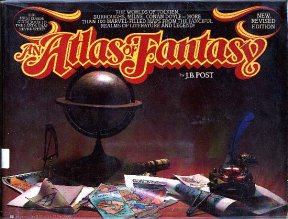
 An Atlas of Fantasy by Jeremiah Benjamin Post 


A fun collection of fictional maps, often from some surprising sources. A good rainy-day book.