Sunday, August 12, 2012

My Favorite Starships

Lists abound in the internet ether. So, why not make one of my own? Here's a subject near and dear to my heart - my favorite fictional (and maybe a few not-so-fictional) starships. There's no particular order here.


Cygnus – Parked at the brink of the event horizon of the titular Black Hole of Disney’s first PG movie, the Cygnus hangs like a celestial Gothic cathedral on the edge of Hell’s gate. It’s a combination of delicate detail and imposing size, golden light caged by dark metal. 


C-57-DForbidden Planet, the 1956 science fiction classic, turns the ‘50s obsession with UFOs on its head, casting a flying saucer in the role of an Earth-based ship manned by humans. The C-57-D is a United Planets cruiser patrolling the spaceways. Its crew would be echoed a decade later in Star Trek, and the C-57-D itself would be echoed in the design of the Enterprise. One of the things that really endears this ship to me is that United Planets cruisers don’t even rate individual names, and are identified only by a number/letter combination.


USS Saratoga – The SCVN 2812, a Kennedy-class nuclear space carrier in the US Space Navy, is the base ship for the plucky Marine pilots of the short-lived Space: Above and Beyond. Basically a flying brick, the Sara was a big brute of a ship, equipped with an air/space wing of fighters and powerful weapons of its own. In effect, it was an Imperial Star Destroyer done right. When Commodore Ross growled “take that thing out of my sky,” there was no doubt the Saratoga could do so.


Carl Sagan’s Dandelion Seed Ship – This ethereal, delicate vessel floated across time and space, opening up the vast cosmos to me at an impressionable age. Sagan working the jewel-like controls in a vaguely church-like bridge had the potential to look silly, but it ended up looking timeless and inspiring.


USS Enterprise – Spare and utilitarian, the most iconic of science fiction ships explored the galaxy on the original Star Trek. There is an implied pragmatism to it, with engines held away from the ship on spars, yet there is a simple, timeless beauty. It would be redone as a more sleek, streamlined vessel in the movies, but I have always preferred the original, which looks like it could be built by NASA in a few decades.


ProtectorGalaxyQuest may have been a parody and satire of Star Trek, but unlike most such lampoons, they didn’t skimp on FX or designs. The Protector is a beautiful ship, graceful and clean-lined, obviously inspired by the Star Trek movies’ sleek Enterprise. Yet, it has a memorable look of its own. Give her a competent crew and send her on a mission, Hollywood!


Warlock – Menacing and jagged, this ship design came late in the Babylon 5 story, appearing briefly in a movie and in the B5 sequel TV series Crusade. That’s too bad, because it’s a badass spaceship. 


HyperionBabylon 5 came up with a lot of nifty spaceships, and the Hyperion heavy cruiser is another one of my favorites. Its resemblance to a submarine is no coincidence, but the role it plays is more battlecruiser than sub. Though it had been decisively outclassed by its Minbari opponents, it was the backbone of the human fleet up until the time of Babylon 5. It’s a tough-looking, handsome ship.


Narn G’Quan-class Heavy Cruiser, Babylon 5 – The Narn are a massive, reptilian race of aliens with a strong fighting spirit and sense of pride. Their ships reflect a stately bearing with a touch of the brutish about them. The most powerful of them, the G’Quan class, is a big, imposing wedge with a crazy black/red/green paint scheme. These ships seem about as maneuverable as a barge. Moving in a slow and stately fashion may suit a passenger ship, but this is a warship. It helps that it seems to be tough and able to shrug off damage, but it also seems to be technologically inferior to many of its opponents. Regardless, they have an attractive configuration and coloration, and a sense of power about them.


Centauri Vorchan-class Cruiser, Babylon 5 – The Centauri are aliens with an old, decadent empire, and their ships are oddly graceful, as if they were designed as much for style as for function. Plus, most of them are purple, which is an unusual color for spaceships. They look like what they are – the product of a culture long used to traveling in space.


Mule, from Spacecraft 2000-2100AD, part of the Terran Trade Authority (TTA) universe (original painting by Colin Hay, titled Space Tug) – The Mule is a class of space tugs, and looks the part. Simple and ugly, they have a rugged appearance. I dig when artists deal with non-fighting vessels, and the Mule seems like something that might be seen stolidly shoving and pulling other vessels around in some space harbor of the future. This is without a doubt my favorite TTA ship. It isn’t slick and glamorous; it looks like a working ship. I love that about it.


General Products Hull, Larry Niven's Known Space stories – Basically a huge, hollow, transparent needle, these spacecraft hulls are nigh-indestructible. Produced and sold by the Pierson’s Puppeteers, an alien race with a culture based on mercantilism, the General Products Hulls are found all over Larry Niven’s Known Space setting.


Leif Ericson – a classic spacecraft model from the late 1960s, the Leif Ericson remains a popular subject for model-makers. It just looks like a classic starship, though it’s an original design, not based on a movie or book. In fact, the Ericson would prove so popular that it inspired the MacArthur, the main starship in Larry Niven and Jerry Pournell’s classic space opera The Mote in God’s Eye. A variant of it was produced as a glow-in-the-dark model, renamed the Interplanetary UFO Mystery Ship. Regardless of the name or its glow-in-the-dark qualities, the ship has a timelessly retro look that fires the imagination. 


USS Merrimack – The Mack is the heart of R.M. Meluch’s action-packed and often audaciously crazy Tour of the Merrimack series of books. Although there doesn’t seem to be a definitive picture of the ship, it’s described as a big wedge-shape, in my mind’s eye something like a sleeker, more shark-like take on the Imperial Star Destroyer of Star Wars. The books are a rollicking good time, and the Merrimack is commanded by Commodore John Farragut, a space opera hero in the classic mode, surrounded by a whole cast of vividly-rendered characters. Make no mistake; the Mack herself is a character, just as the Enterprise was in Star Trek. Tough, fast, and equipped with space fighters and broadside weapons, the Merrimack is a solid presence in a four-color universe.


Imperial Star Destroyer – Synonymous with Imperial power, the Imperial Star Destroyer looms large over the Star Wars franchise. The memorable image of a Star Destroyer hulking above the audience at the beginning of Star Wars (back before it had “A New Hope” added to it) was an ominous, breathtaking way to firmly establish the power and oppression of the Empire. Yet…they’re paper tigers. Not once do they demonstrate a real knock-out punch when engaged in anything like a fair fight, and they continually have freighters and fighters running rings around them. Their designers seem to have forgotten to provide a really big, decisive weapon. If they did, it was never trotted out in the movies. In a way, they’re symbolic of the Empire itself – huge and menacing, but ultimately ineffectual. Still, for sheer iconic imagery, their big, simple wedge shapes are an indelible part of the Star Wars saga.


Rebel Transport – strangely shaped, like ragged-edged clamshells, the Rebel Transport has a workmanlike appearance nonetheless. However, they have an odd beauty to them, a worn-out, lived-in beauty that is both akin to but unlike that of the Millennium Falcon. One can imagine intrepid crews having their own adventures as they slip through Imperial blockades and smuggle goods to Rebel bases.


Apollo 27, model kit – A fun, retro design, harkening back to an age when spacecraft were sleek and stylish…at least, in our imaginations.  Sure, it’s impractical, but we can only hope real spaceships end up looking this cool. This is a throwback to when models could be whimsical and not have to be based on a well-established franchise.


Discovery – Spare but elegant, the Discovery is a hub of mystery in both the movie 2001 and its long-afterward sequel, 2010. Yet, it still has a realistic, practical look. Its brightly-lit, white interior somehow adds to the sterile, implacable horror of a computer gone mad. 


Klingon D-7 – The sleek angularity of the quintessential Klingon ship from the original Star Trek TV series evokes a feeling of alien menace. It’s oddly graceful, yet an unmistakable threat.


Romulan Bird of Prey – A really ungainly design, this ship always struck me as being technologically behind the times in comparison to the Enterprise, retrofitted with a powerful weapon to close the gap between the Romulan Empire and the Federation. The comparison between it and a submarine, at least in purpose if not intent, is obvious, and brings with it the claustrophobic “feel” of a submarine movie.


Ragnarok Orbital Interceptor – Many, many Moons ago, I owned and assembled this model kit. Bearing a resemblance to real-world X-craft and the SR-71, I was fascinated by this model. The parasite fighter nestled in the tail of the plane added to the fun. OK, so technically not a spaceship, I always pretended it was.


Eagle – The iconic utility space vessel of the TV show Space: 1999. Show creator Gerry Anderson is famous for his puppet-based movies and TV shows, primarily Thunderbirds. Savagely – and hilariously – lampooned in Team America, Anderson’s style is unique. His various vehicle designs are attractive and somehow realistic. When he decided to do a science fiction TV show, he went with human actors instead of puppets, but retained his trademark model work for Moon Base Alpha and its fleet of utility spaceships. The Eagle looks like a real spacecraft design. The only beauty to it is its pragmatic look; you can just tell it’s a working vehicle.


Y-Wing Fighter – Sure, the X-Wing is the sexy beast for the Rebel Alliance, but the Y-Wing has the appearance of a workhorse. Tired, maybe, but tough, with no frills and exposed wiring and tubing. This is my favorite Star Wars ship. 


Shapieron – This ship is from James Hogan’s Giants series of books. Flung 25 million years into the future – our present – by moving at relativistic speeds (more or less, as I understood it) the Shapieron belongs to the Ganymeans, an alien race of giants whose very physiology discourages violence. The Shapieron is a well-worn ship, and my understanding of its appearance is that it’s in the classic delta-V mode, though more organic – but maybe my mind’s-eye has the description wrong. But what’s important is that the Shapieron is a sturdy, dependable ship, home to its crew for its impossibly long voyage. It also houses one of the great artificial intelligences in science fiction, ZORAC. The picture is the cover of the third book in the series; it may depict the Shapieron, given that it’s roughly the same shape as described in the books. Not much like I envision, but still nifty, and by the late, great Darrell K. Sweet.


Rama, from Rendezvous with Rama by Arthur C. Clarke – An enormous flying tube, from parts unknown, hurtles into the Solar System. Humans send a ship to rendezvous with it, and find it to be filled with the makings for a colony or planetary ecosystem construction. I’ve only read the first book of what became a series, but I enjoy the sheer mystery of Rama, as it brakes and then proceeds to slingshot off the Sun’s gravity to fly out of our space. Rama is an enigma, underscoring the immensity of space and its endless possibilities.


Valley Forge - the 1971 film Silent Running, starring the often-askew Bruce Dern, presented some unique and interesting ships, further examples of fictional ships that look like they could be on NASA’s drawing boards. The Valley Forge consists of a tug or transport vessel with domes attached. These domes contain the last of Earth’s wilderness flora and fauna. The ship has a stark, practical look, another working vessel, but with a few bits of beauty attached. The model would later be reused for the original Battlestar Galactica.


Satellite of Love – The setting for Mystery Science Theater 3000, the SoL (get it?) was both home and prison to Joel, then Mike, and their robot buddies Tom Servo and Crow T. Robot. Shaped like a…bone, the SoL seemed ruled by cartoon physics and logic. 


The Great Unmanned Space Vessel, from the book Galactic Aliens – Weird and organic-looking, this thing is stupendously large – 16,000 km in length! Its passengers long-since killed off, this pushing-10,000-mile-long ship is now maintained by robots. The trouble is, the aliens that built it were extremely xenophobic, and the ship’s programming now directs it to destroy all life it encounters, helped along by its impenetrable force field and overwhelming weaponry. Silly fun from a goofy book. 


Saucers from Earth vs the Flying Saucers – Ray Harryhausen brings to life some of the most spectacular flying saucers to grace the screen. They have a distinct whine as they fly, that rises to an eerie howl when moving quickly. Toss in a force field of some kind, death rays, and wavery-voiced aliens in cool armored suits, and these are the saucers that leap to mind when ‘50s scifi is the subject.


Buck Rogers Starfighters – The TV show was campy and silly, but the Earth-based starfighters were still all kinds of cool. Barbed and graceful, they looked like they belonged in another show.


Close Encounters of the Third Kind Mothership – I saw Close Encounters at the theater when it was released, and the appearance of the Mothership was truly awe-inspiring. A great flying city of the night, lit up like a Christmas tree, carefully and effortlessly flipping over as it prepares to land is one of the most memorable scenes ever in cinematic science fiction. 


Space Battleship Yamato – The ship around which the Japanese animated TV series Star Blazers was based, the mighty Yamato was the refurbished World War II-era Japanese superbattleship of the same name. Bristling with weapons and possessed of a wing of space fighters, the ship was built around its ridiculously powerful wave motion gun, which could destroy planets. When the wave motion gun was fired up, everything else paled in comparison. A wide variety of similar-looking ships would eventually crowd the Star Blazers universe (check out the wonderful Andromeda, for example), but the Yamato was the first and most-beloved.


Battlestar Galactica – This is an iconic ship in science fiction whether it’s the stalwart original or the sleeker, segmented-looking revamp. The original has a stately look, dignified and utilitarian, while the updated version reminds me of a grim, close-up fighter with a surprising jab. The concept of a carrier in space which is also heavily armed and armored has always appealed to me. 


Interstellar craft from Cosmos, the book – Carl Sagan included some schematics for possible interstellar spacecraft in the book, Cosmos. Their inclusion added to the wonder I felt from reading this book and watching its subsequent TV companion. Though ungainly-looking, they lent an air of excitement to the notion of travel between the stars, because these ships looked real


X-Wing Fighter, Star Wars – I almost left it off the list. It’s almost too iconic, too ingrained into my psyche as a science fiction fan. It almost goes without saying this ship is among my favorites. Sure, the Y-Wing became my favorite, but the X-Wing long held the top spot. To me, this ship is indelibly etched on my mind, the first image that leaps to my mind when I think of Star Wars. It just looks like what it is – a space superiority fighter.


TIE Fighter, Star Wars – And what is the X-Wing without its eternal nemesis, the Imperial TIE Fighter? It lacks grace and beauty, and seems as durable as a soap bubble, but it’s the ubiquity of the ship that makes it a perfect foe for the Rebel Alliance. Plus, its distinctive screaming roar – regardless of the fact that there is no sound in space – is among the most recognizable sounds from film.


Friday, August 10, 2012

Worlds That Never Were: Books of Fictional Places


I've always been fascinated by maps and books that detail places, especially fictional places. These are some of my favorites of those books. I've linked to them on Amazon, but find them wherever you can; I don't have any kind of deal with that bookseller.


Gorgeous concept art and straight-faced prose paint a convincing picture of that doomed island. Skull Island is densely populated with the descendants of Cretaceous-era dinosaurs, as well as a riot of birds, reptiles, insects, mammals, and even humans, who have evolved in convergent and divergent ways. Cyclopean ruins loom over parts of the island, and are being reclaimed by the fecund and dangerous wild. A wonderful setting for adventure, only a tiny bit was explored in the Peter Jackson film. A detailed map and a fold-out size comparison chart of Skull Island's denizens helps round out this very nifty book.


The conceit of this book is that somehow man has vanished from the world, and fifty million years hence a mysterious naturalist explores the ecosystem of a world that would have been at once familiar but also very alien to man. A study in how evolution works, this book is also an intriguing bit of speculative fiction.


Dougal Dixon, the author of After Man, posits another alternate Earth bereft of humans. The time is now, but a "now" 65 million years after the dinosaurs did not vanish, but instead continued to thrive and adapt. Many of the animals are hauntingly familiar as they fill niches filled by animals we know today, while others are bizarre yet logical adaptations to new environments. A great companion piece to After Man.


Mankind has spread to the stars and is colonizing planets in other star systems. Detailed overviews of eight planets are the bulk of the book, with benefits and drawbacks for potential colonists given, as well as meticulous maps. The application to be a colonist is a fun added touch.


Profusely, and at times, disturbingly, illustrated, this Transylvania seems to be rife with sorcerers, barbarian swordsmen and -women, and demons and undead aplenty. Zombie farmers, cursed monasteries, guard towers on Hell's borders...all are discussed in serious guidebook prose, sometimes with a dry wit.
  
The League of Extraordinary Gentlemen, Vol. 2 by Alan Moore and Kevin O'Neill


This volume of Moore and O'Neill's adult-themed comic provides a fascinating prose overview and travelogue of the entire world. There are some amusing, and occasionally subtle, references - this is a world on which King Kong, Conan the Barbarian, and the Dude from The Big Lebowski have trod (or will).

 Invisible Cities by Italo Calvino 


Kublai Khan demands to hear of the many cities Marco Polo has encountered in his travels, but this isn't the historical Khan and Polo. The result is an unfolding dreamscape of cities that do not and cannot exist, but are beautiful all the same.


A thick, massive book, in which one can get lost for hours in the entries, which range from the familiar places of modern literature to the (very) obscure realms of centuries-old texts.


Using the original source material and a fine-honed attention to detail, the late Fonstad created this atlas, which could become indispensable to the Tolkienophile.

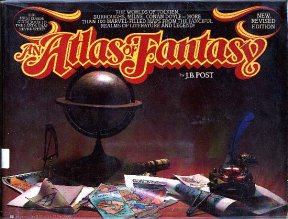
 An Atlas of Fantasy by Jeremiah Benjamin Post 


A fun collection of fictional maps, often from some surprising sources. A good rainy-day book.

Monday, August 6, 2012

Off the beaten path: Dunland and the Southern Misty Mountains


My philosophy is that I'd rather a game book go off the rails into lunacy rather than remain on the rails and be boring. Dunland and the Southern Misty Mountains is one of those instances where the rails are a mere suggestion, with a rail car bouncing loosely along, much like in Indiana Jones and the Temple of Doom. It never quite flies completely off and into the abyss of insanity, but you can see it looming below.

OK, so that's a bit of an exaggeration.

Much of the book is solid extrapolation, such as in how it attempts to derive the culture of the Dunlendings from what Tolkien wrote, or at least from what was suggested by what he wrote. The Dunlending culture in this book is vaguely Celtic in flavor. A good bit of the book is taken up with an overview of Dunnish culture, with attention paid to its history, tribes, customs, and territory. As a culture, they were traditionally hostile to the Dunedain and their allies, at least after they betrayed their oath to aid the Men of the West in their war with Sauron. The Dunlending culture was cursed, until by the time of The Lord of the Rings, they were a people in decline, living a desperate and wild existence in the empty lands in the southwestern part of the Misty Mountains and their surroundings. This is actually pretty interesting and useful material, even if one doesn't use it in the Middle-earth setting. As far as I can tell, most if it is made up whole cloth for this book. That's not bad, but it isn't a good source for Tolkienophiles.

Rohan and the Southern Misty Mountains
I've mentioned a number of times in this series of posts on the Middle-earth Roleplaying line that they have some beautiful maps. This is a good example of what I mean. It's only half of one of the maps covering the region detailed in the book. I chose to show this half because it covers some territory more familiar toTolkien fans - Rohan, Fangorn, and Isengard, called Angrenost on this map. It's quite a pretty map, a real work of art. It would have been fantastic had the entire thing been published as one big poster-map, but as far as I know it never was.

The Misty Mountains are an interesting locale in Tolkien's books. They harbor as many secrets as Mirkwood, it seems like. In The Hobbit, they are home to giants and underground goblin lairs. In The Lord of the Rings, they are home to Moria, also known as Khazad-dum, the legendary fortress-city of the Dwarves, now infested with orcs and much more terrible things. In both books, terrible storms seem to loom over them, waiting to strike, as though the mountains themselves begrudge those who trespass upon them. They retain this mystery and danger in this book, with giants, dragons, and Great Eagles calling them home. This is also where a touch of lunacy enters the picture.

Deep in the Misty Mountains, north and east of Isengard, lies Amon Lind...at least in the Middle-earth of this book. I can't imagine this place ever being approved by Tolkien himself. Amon Lind is an isolated enclave of Elves who moved from Ost-in-Edhil centuries ago to "escape" the "confines" of Elven society. For the most part, they are pretty tame in their "rebellion" against Elven society. The strangest among them, though, is a sadistic Elven version of Dr. Moreau, experimenting with the grafting together of Men and Elves with animals. He uses these animal-men as servants and guards. Add in that Amon Lind also has a flying boat at its disposal, and the boundaries of what is truly Tolkienesque are pushed to the breaking point. This would all be interesting in another setting, but they just don't fit in Middle-earth, at least not in my reading of the source material.

OK, so I'm always quick to point out that it's easy enough to ignore or alter things you don't like in these game sourcebooks. That's true in this case, too. Eliminate the mad scientist elf and his creations, and Amon Lind becomes a lot more palatable to a Tolkien fan like me. I'd also get rid of the flying boat, even though some might try to justify it by pointing out Earendil the Mariner had one...which is a pretty weak justification. Earendil was a special case, a legendary figure granted the mystical ability to carry the morning star on his brow. So let's be reasonable. Amon Lind, with those few tweaks, can be an interesting surprise for those who explore deep into the Misty Mountains.

So what else does Dunland and the Southern Misty Mountains have to recommend it? Plenty. The usual slate of charts of characters and critters that can be encountered in the region is here, as well as details of the flora and fauna. The stomping grounds of a dragon is located in the mountains, as is the aerie (or eyrie, as spelled in this book) of a Great Eagle. This Eagle also guards the final resting place of Isildur, Aragorn's long-ago ancestor, a nice reference to Middle-earth history. In addition, and perhaps one of the nicest touches, is a tiny hobbit village, its inhabitants among the stragglers who have yet to migrate to the Shire.

Wild Hobbits? You bet.
The bulk of the book deals with the Dunlendings and Amon Lind. The remainder of the book is varied and interesting. Some tragic history, a bit of whimsy, a hint of lunacy...it all adds up to a surprisingly interesting book.


A Space Opera Interlude: A Rising Thunder


The plucky Star Empire of Manticore has much more than its fair share of trouble to deal with on a regular basis. Whether it's political corruption or fleets of superdreadnaughts, the Manticore binary system has seen it all. This latest volume in David Weber's epic recounting of a future history once again ramps up the perils that are hurled at the little star nation, sometimes literally at hundreds of times the speed of light.

For those who wish to read this book or the entire series, be warned that I will be dispensing SPOILERS like a Manticoran task force dispenses missile pods. Which is to say, stop reading unless you want the story spoiled, 'cause I'll be spoilin' it but good. Haven't read the "Honor Harrington" series? Well, there's not much keeping you from it; most of the series is available for free, legal download at places like this, which hosts the material found on CDs bound into many of Baen Publishing's books. Tons of free reading, not all of it by David Weber.

This volume, the 13th in the series - though there two ancillary series consisting of two books each (so far) and a five-volume (and counting) series of anthologies - continues to expand the scope of the saga in ways which would likely astonish someone who has just started reading, or even someone reading just two or three books back.

I love these books beyond all reason. They're addicting. Some volumes seem extremely overwritten; maybe they are, but to me, Weber was laying an intricate foundation for what was to come. A millennium of history has been laid out. Several constellations worth of planets have been detailed, each with their own story. Hundreds, maybe thousands, of characters have come and gone, all with roles to play, sometimes reappearing unlooked-for, sometimes dying. It's difficult for me not to love such a fully-realized setting.

Never let it be said that Weber is afraid to kill off characters. He famously had marked even the titular character of the series for death in At All Costs, and you can see him building to it. He relented due to the influence of, among others, his wife, but even before that, he didn't shy from running Honor through a gauntlet in previous books. I have felt more than once she wouldn't survive the book I was reading at the moment. Though she has survived, many others, some long-familiar to the reader, have given up the ghost along the way. I'd gotten so used to the mortality rate for characters in Weber's books that I took the opportunity at a book signing to ask him not to kill off Admiral Lester Tourville - what can I say, I dig the guy. Weber jokingly replied that his wife had warned him to leave Tourville alone; subsequently, Lester almost tasted vacuum a few books later in a nail-biter of a space battle.  So the Fickle Finger of Fate seems poised, ever-ready to poke down on one character or another.

Get ready for the SPOILERS. Don't say I didn't warn you!

As the book begins, the newly-minted Star Empire is still reeling from a surprise attack in the previous volume in the series, Mission of Honor, that has left its industrial base in tatters. The assailant is still something of a mystery, despite the general direction of the attack's origin being known. 

Long-time Manticoran nemesis, the Republic of Haven, had been poised to surrender just as the sneak attack caused the recall of the mighty Eighth Fleet and its commander, Honor Harrington. Eloise Pritchart, president of the Republic, makes a surprising decision at the end of Mission of Honor of just how to take advantage of this respite from total defeat, one that would have been unthinkable not many books ago. She has received information from super-spies Victor Cachat of Haven, and Anton Zilwicki of Manticore, that reveals a conspiracy of such scope and age that it far outstrips that of the Illuminati, a conspiracy that has been using Manticore, Haven, and the Solarian League itself as pieces on a galactic board. Is it possible for Manticore and Haven to set aside their differences in the face of this secretive mutual enemy? Pritchart decides to take a chance in finding out.

The vast and ancient Solarian League, centered on Earth, with its capital in Old Chicago, smells blood in the water. The League, long in the background of the "Honor Harrington" series, has always loomed as the ne plus ultra of human star nations, its Navy seemingly invincible...seemingly. The lie was put to that in Mission of Honor, as the League was on the receiving end of decisive defeats at the hands of Manticoran fleets. The League, endlessly corrupt and imperialistic, now seeks nothing less than the total surrender of Manticore. The Solarian League Navy sends the largest fleet ever assembled in its history to the Manticore Binary System.

So, things are looking pretty bleak for the Star Empire.

A lot of criticism has been leveled at Weber for the decrease of space battles in this series, and the increase in endless Machiavellian political meetings. Certainly the recounting of ship-to-ship and fleet-to-fleet combat has become a rarer thing as the series has progressed. Weber is a true master of such scenes; he has meticulously figured out the technical details of his future weaponry and propulsion systems, and carefully lays out the physics and tactics involved in all his space battles. The specificity is what is appealing; there is no authorial hand-waving once battle is joined. Few things in science fiction literature are more satisfying than Weber's starship battles. What the critics seem to be overlooking is that significant chunks of even the talkiest book in the series is taken up by the descriptions of space conflicts. At this point, though, Weber has, in retrospect, clearly been laying the groundwork in the past several books for a grand conflict that involves all of explored (and some yet-to-be explored) space. All those clandestine - and some not-so-clandestine - political machinations are now bearing fruit, as the reader sees that a manipulative hand from the shadows has been guiding the course of conflicts for a long time.

A Rising Thunder has everything I've come to expect from an Honor Harrington book: starship battles; base treachery; astonishing technology; noble starship commanders; craven politicians; espionage; media manipulation; impassioned speeches; extreme melodrama; and much more, like the treecats of Sphinx pledging their support in the coming war. There's even a wedding. Yep, a wedding.

One of the things I like the most about this series is that while there are certainly bad guys and enemies that need defeating, Weber makes a point of providing any side of a conflict with sympathetic characters. I often feel more than a twinge when a battle brings characters I like on both sides into conflict. The Star Empire of Manticore is the home of the "good guys," but there are plenty of "bad guys," so to speak, that are likable and whom I wouldn't want killed - Lester Tourville, for example.

The Honor Harrington books compose my favorite science fiction series, bar none. A few books back I felt they bogged down and seemed unfocused. It seemed as though Weber was looking for a way to reconfigure the overarching plot for his future series after forgoing causing the demise of his most famous character. This is borne out by his assertion that his original plan was for Honor's son to become the center of the saga a couple of decades after his mother's death. He accelerated that plot to accommodate Honor's continuing existence, which took a couple of books to accomplish, and now the series seems to have come back on the rails. It's difficult to tell now if Weber has an endgame planned out, but I tend to think so. The decaying and fragmenting Solarian League provides both the opportunity to draw Honor's story to a close, but still leaves almost endless possibilities for future books in the "Honorverse." I hope so, because I have enjoyed being immersed in this setting, and this book brings the series back on track. Perhaps not the track of the earliest books, but it's an interesting ride, regardless.


Thursday, August 2, 2012

A Wizard in his Tower: Isengard and Northern Gondor


"My business is with Isengard tonight," Treebeard, The Lord of the Rings, The Two Towers, Book Three, Chapter IX: Flotsam and Jetsam 

Towers hold a certain kind of mystique in legend and literature. Jutting upward, pointing to the sky, they have an air of mystery to them, whether they appear in fairytales or occult legend. Rapunzel was imprisoned in one, Rumpelstiltskin spun straw into gold in one, Conan the Cimmerian found adventure in one, the Tower of London is steeped in history and legend, and, of course, the Tower of Babel may be the most famous of all.

The Tower of Babel as seen in Gustave Dore's The Confusion of Tongues.

 Even today, towers inspire fascination, with the skyscraper being the most prominent component of modern cities; having the tallest of these tall buildings confers considerable prestige upon the cities they shadow. Towers also loom up in other contexts in today's world, providing security in prisons, inspiration for worshippers, and nerve centers for airports.

So, it's not surprising, really, that Tolkien included so many towers in The Lord of the Rings. In Rohan, there was the Hornburg of Helm's Deep. Ancient Elvish towers stood to the West of the Shire upon the Tower Hills. The Tower of Ecthelion stood proudly above Minas Tirith. The Tower of Black Sorcery looms above Minas Morgul, which was once Minas Ithil, the sister-city to Minas Tirith. Grim Barad-dur is the focus of the greatest evil of Middle-earth as the abode of Sauron. 

And, of course, there was Isengard.

Well, technically, Isengard was the entire fortress, the ring of stone and the tower in its center. The tower was named Orthanc. Orthanc was built by some mysterious method in the Second Age of Middle-earth. It consisted of four piers (stelae? menhirs?) of obsidian-like material fused into one structure. I say "obsdian-like" because Tolkien describes them as "many-sided" and black, which strikes me as being a good description of obsidian, with the way it has facets when cut or broken.
See?


It seems it may not have been obsidian, or at least not normal obsidian, because it was impervious even to the Ents, who could easily rip apart stone walls when they were angry. It sure wasn't for lack of trying that they didn't damage Orthanc.

Isengard was meant to guard the western approaches to Gondor. As Gondor's borders slowly receded, it eventually became an isolated place, and was granted to the wizard Saruman as his sanctuary and laboratory.

Wizards have a long history in legend of being associated with towers. It makes sense, really; towers are defensible, and give a good view of their surroundings. They also can be imposing and ominous, scaring away intruders. They place their inhabitants up above mortal concerns, figuratively and literally, and provide a good place from which to study the sky. This is an important consideration because of the one-time close association between magic and the stars and planets. Astronomy and astrology were once the same thing, essentially, and they figured prominently in magic creation. Even Doctor Frankenstein worked in a tower, at least in the 1931 movie. I'd love to have a screen shot to show you, but I don't. Just take my word for it. So, it seems natural now that Tolkien included a wizard in a tower in his book.

I'm discussing all this because the bulk of Isengard and Northern Gondor deals directly with, obviously, Isengard, and especially Orthanc itself. There is some material on Calenardhon, the northern province of Gondor that a millennium from the time setting of this book, given or take a century, will become Rohan. Herbs, animals, some cultural notes on the inhabitants, items of note and legend, adventure ideas, the lay of the land, and histories of the region, Isengard, and Saruman are all included, succinct and useful. 

Interestingly, there is a brief overview of the Druedain, or Woses, the primitive, Neanderthal-like people who had some friction with the Rohirrim, which is more substantive than the entry for them in Riders of Rohan. Given the brief though important role they play in the Rohirrim making it in time to aid Gondor, it strikes me that more about them should have been included in the book about Rohan.
Theoden meets with Woses led by Ghan-buri-Ghan in this painting by the Brothers Hildebrandt.

The Hornburg and a few other, lesser strongholds and settlements are detailed, but like I said, the star of this book is Orthanc. A nice, color map of the tower is included, with an interesting depiction of the fortress from the outside. It's unusual for the Middle-earth Roleplaying line to include a color picture of a site on a map. The map shows the layout of the multiple levels of the place, and there are other maps showing underground levels.

By popular demand; not a great picture, but the best I could do with what I have.

When it comes to how the book covers Orthanc, it is strongly reminiscent of Dungeons & Dragons adventures. It's a pretty standard "dungeoncrawl," though there isn't a lot of variety in the inhabitants of the place - mostly Men and Orcs, the latter appearing after Saruman's treason. There are quite a few tricks and traps to vex invaders. Oh, and Saruman lives here after a certain point. That makes the place especially dangerous.

This entry in the Middle-earth Roleplaying line is solid, though not as interesting as others in the line. The cover art is by Gail McIntosh, who did some of the covers for early books in the line. It's a well-done picture, but I think an image emphasizing Orthanc more would have been appropriate. The interior art is pretty sparse, and only one depicts anything of note, and even then it took me a while to realize it was meant to depict Saruman and Wormtongue.
Umm. No.
In all the times I've read Tolkien's book, I never had an image of Saruman anything close to this. And let's not even bother to discuss Wormtongue in this picture. I always thought the interior art in the MERP books was very hit-or-miss, and this book was a definite miss. From a technical standpoint, it was actually pretty good:

But from the standpoint of really evoking the setting? It just doesn't work. I suppose that the paucity of art in the book was actually preferable to a lot of art that didn't seem all that tied to the setting.

This book is an interesting contrast to the previous one I discussed, Riders of Rohan. I think I've had it even longer than that book, as Isengard and Northern Gondor is definitely from earlier in the history of MERP. Regardless, I've forgotten I owned it from time to time, including when I started to do this series of blogs. Doing the Rohan post jogged my memory, and I dug it out to write about next because it complements the Rohan book. I see why it doesn't evoke any kind of deep memories; it seems thin to me. Had it focused more tightly on Isengard itself, making it more of a site-based adventure, it may well have been a classic of its kind. As it is, it's useful, but forgettable.